Today, I officially became a woman in Japan.
Coming of Age Day (成人の日 – seijin no hi) has been celebrated in Japan since 714AD, and officially became a public holiday in 1948. It celebrates the beginning of adulthood for boys and girls who have turned 20 in the previous year, and can be quite a busy and emotionally loaded day for parents. It’s like the big 21st birthday the Western world celebrates, but at the same time nothing quite like it. For starters, everyone celebrates it on the same day.
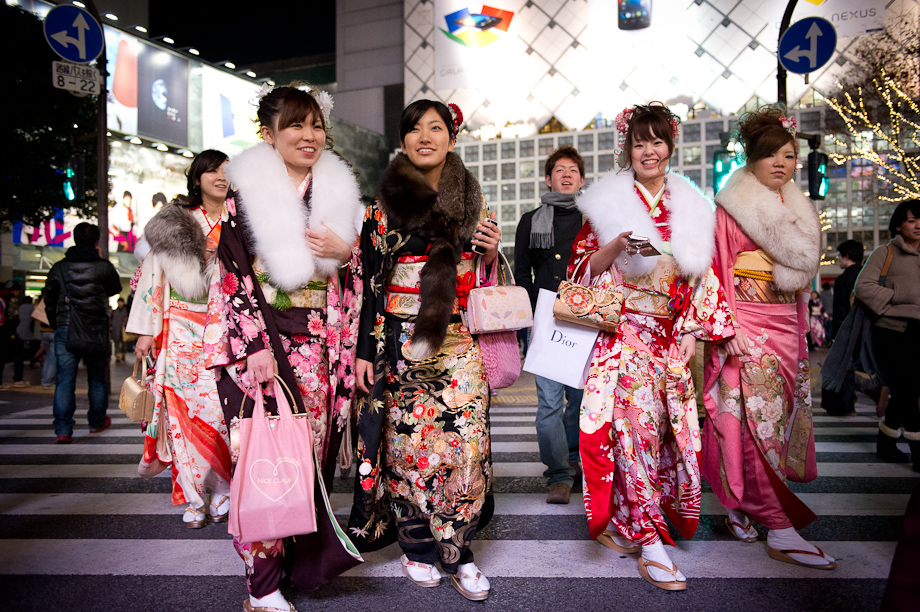
Shit, that’s over a 12,000 NZD(!!???) I’ve never worn, let alone touched anything so expensive. She told me that’s a reasonable price for a proper kimono. While bright-coloured, non-silk, Made in China kimonos are common for rental these days, you can easily tell the difference between the two. The attention to detail and the effort that goes into maintenance of traditional kimonos go beyond Hannibal Lector’s well-thought out meal plan. It’s psychotic and OCD. There were 6 towels, and bits of cotton neatly folded within every corner of the kimono. This was done over 30 years ago, so whoever was blessed enough to wear it further down the track wouldn’t be troubled with crinkles or mould problems. There were over 40 bits and bobs which I had no idea what went where, or whether it was actually wearable, so I was ordered not to touch anything.
(On a funky side note, I asked Mr Google how much rental kimonos were. After typing in ‘rental’ Google suggested ‘rental girlfriend Fukuoka.’ What might seem like a lol to you guys actually highlights a serious social issue in Japan. These things are real, a survey by the Ministry of Health, Labour and Welfare in 2010 found 36% of Japanese males aged 16 to 19 had no interest in sex – a figure that had doubled in the space of two years. They prefer virtual girlfriends – animated ones that don’t argue back (lol I stand no chance with Japanese men). There’s an interesting BBC doco on this if you’re weird like me and you’re interested in the world of virtual girlfriends and modern relationships in Japan!)
 Anways.
Initially, I was excited to wear a proper kimono for the first time, but halfway through this agonising process I was tapping out – KO, I’m throwing in the towel!
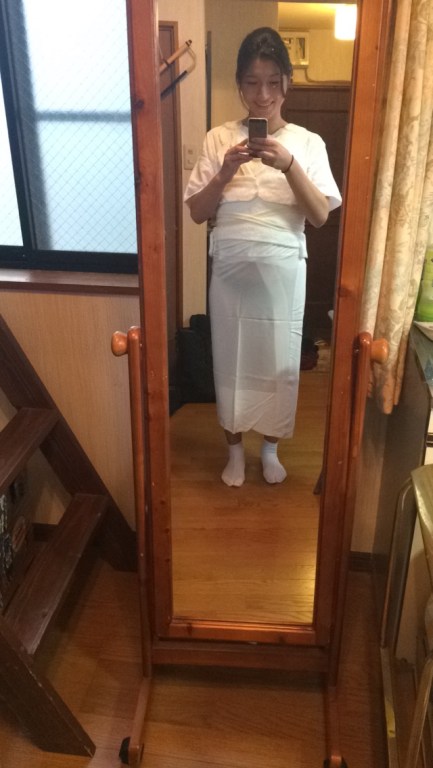
I had 5 layers lathered over me, with towels and bits of cottons stuffed in my midriff and chest area to make me look more full-figured. 10 ropes, 1 cardboard and 2 belts were wrapped around my waist to keep everything in place. My boobs (what boobs, eh?) were squashed, my movement was restricted, there was no chance of me going for a wee anytime soon, and I couldn’t breath. I seriously thought I was going to suffocate. In the above photo, I’m 10 minutes into this 30 minute torture session, and I’m looking like a middle-aged mushroom who’s been too keen on the festive food. All this pain to look beautiful? Is this even beautiful?
So it got me thinking – sure, I think women in kimono look stunning. But it’s a different ideal of beauty to the western world. For starters, despite my protests, I was made to wear foundation that didn’t match my skin tone to make my face look whiter. I was also told I needed more towels stuffed into my kimono to get rid of any curves.
Why do we go through so much effort to look as further away as possible from what we actually look like? I find it perplexing that Japanese women want to look fairer, because we’re all naturally quite tan and a lot of people aspire to be tan. But being tan is a sign you’ve been out in the sun heaps – that you’re part of the working class. All my friends wear ‘whitening cream’ – like seriously, it’s MJ’s world. It’s the same in Thailand too – you’ve probably seen the controversial whitening cream ads on social media everywhere!

Then my mates in New Zealand are always working on that cocoa glow: sunbathing, and ritualistically applying fake tan before a night out in town. Which ideal do I pursue? I have no f-ing clue. It’s odd, straddling a world that has two utterly different ideals of what is beautiful, and the more I chase one ideal the further away I get from the other. But anyway, today was a day I lived up to the Japanese standards.
And don’t get me wrong. Despite all this whining and complaining, I think the culture of women wearing kimono is something Japan should be proud of, and I hope this tradition won’t vanish away like some of the others. Rather than chasing western ideals by dying their hair blonde and getting mini surgeries to get bigger eyes, young women of Japan should be proud of classic Japanese beauty.
Anyways.
So usually on this day, you get a professional photo taken of you, go to the ceremony at your local city hall, go get some food with your fam, then go drinking with your mates cause yay, you’re legal! But kids like me who only come back for the university holidays miss the actual ceremony on Jan 11th, so we skip the ceremony at the city hall bit and do everything else.

I’ll skip the boring bit. The whole thing was quite a blur anyway. I was feeling dizzy and faint since I hadn’t and couldn’t eat that much that day (and those who know me know hangry Tomo is seriously impaired and moody.) And to repeat – I had 10 ropes, 2 belts and 1 cardboard that was asphyxiating me. I was so hungry but had no desire to eat, since there was not even the slightest room in my body.
As soon as I was released, I headed into the city to meet up with my good old mate Alayna, another half-cast like me. Over way too many drinks at all-you-can-drink Izakaya (literally meaning food-sake shop, where food is dirt-cheap and drinks are usually less than $20 for as much as you want to drink) we yarned about the difficulties we face as halfcasts in Japan, trying to live up to the expectations of two different worlds that have conflicting expectations and ideals. And I’m not talking about just beauty standards – but social, familial and in every other dimension of life. It’s simply undeniable there’s prejudice against us. Why? Well, Japan just happens to be the most secluded and homogenous country (only 1% of Japan’s population is foreign!), where standing out of the crowd is simply not a virtue people pursue. The sheep-herd mentality here is an incurable plague.
And the conflicting beauty standards I faced today was a relatively minor, but a text-book example of being torn between two different worlds. We don’t want to chose between the two because we equally love being both, but sadly it means we are only half of both, lesser than the ‘pure’ blood (sounds like Harry Potter right?) Pure bloods in Japan are fully and entirely of one race, and enjoy quite comfortably a sense of belonging in their community. ‘Hafu’ are those who don’t. The Japanese-English word for ‘half’, products of interracial humpy-dumpy are seen as half of each. Some have argued we should be called ‘double’, not half. The common perception that these children get the best of both worlds is true, but glorified, and the hidden adversities are disguised. Rather, more often they are only partially accepted in both worlds, and often struggle to identify themselves as one, both, or even anything. Most of my hafu friends have had an identify crisis at some point in their awkward adolescent years. (ALAYNA AM I RIGHT??? Check out my hafu mates blog, she touches on this issue too.) When I lived in Japan, I tried super hard to be extra Japanese – dying my hair black, denying my Kiwi heritage, doing everything to fit in. Then at one point, I denied my Japanese heritage in my awkward adolescent boarding school years – dying my hair blond (god, wtf was I thinking) trying so hard to speak with a kiwi twang, and dropping habits that all my pairs scorned and said “Omg, that’s so Asian!” What do you become when you are slightly one race, not entirely accepted in either, and torn between two polar opposite worlds?
I am Japanese-Kiwi, Kiwi-Japanese; it seems like whichever race you put first when you describe yourself is ascribed with more weight. But I don’t want to give weight to one part of me more than the other. It’s true a lot of hafu kids identify themselves as one race than another, whether its because they only speak one language, brought up in one country, or sadly never got a taste of the ‘other’ world they are awkwardly connected with, despite the saddening reality it’s distant to their everyday life.
It seems like I’m going in a tangent but I’m really not. The prejudice hafu kids face was relevant to me on this day, because taking part in this ceremony and becoming an adult in Japan means I’m acknowledging the importance of my Japanese heritage and identity. I’m no longer trying to be super kiwi or super Japanese, but I’ve finally come to terms with who I am (lol cheesy.)
Anyway, after hitting a few bars, we ended the night like any good night in Fukuoka ends – karaoke followed by pork ramen at 3am. After all, we are the ramen capital of the world!


Anyways, happy Coming of Age day to everyone who became an adult in Japan today! 成人さん達おめでとー 🙂 I’m v concerned since I still feel immature AF, but I’ve officially entered a new chapter in my life!&#^@&*#^&*@^#*&!!!!
 Lost in Gustation
You must be logged in to post a comment.