With only a few days left in my favourite city on earth, Fukuoka, I was yet to treat myself to my sworn death-bed food: grilled eel on rice. A screwed up choice some might think, and I admit that it requires an acquired taste. No, actually not really: but for people who just can’t kick the image of a slimy black eel out of their head when chomping down this delicacy, the sheer thought of it might make it taste like absolute shit. But not me. The thought of a slimy eel excites me more than it should. So one night, Dad and I decided to take an adventure out to a neighbouring city Kokura, just to eat eel.

You might wonder, why the heck would anyone travel to another city just to eat eel, when there are local eel restaurants everywhere!? Well that’s a question that begs another question. Why do restaurants dedicated entirely to eel even exist? This requires a brief explanation of the fascinating, complicated and incomparable culture that surrounds Japanese cuisine.
When I’m in New Zealand, I go to a restaurant or a café. What kind of a restaurant or a café, you may ask. Well, there’s steakhouses, Malaysian restaurants, yum cha, Italian restaurants, and brunch famous cafes etc etc. The system in Japan is slightly different – you don’t go to a Japanese restaurant or a café: you go to a restaurant for a specific kind of dish, ingredient or a cooking method. Everything is super specialised, because its thought that specialising in one thing makes it easier to master the art of cooking that specific thing. So deciding what you want to eat before you get there is crucial! You can’t just turn up to a soba noodle shop and decide you prefer ramen noodles, or that you’re craving Teriyaki chicken on rice. (Not that that’s really Japanese food – it’s westernised and equal to butter chicken of India -_- ) So eel is a defined category that many, many restaurants specialise in. Cooking eel right is thought of as a difficult art to master.
So one night when I turned on the TV, unsurprisingly for this food-fanatic nation, 5 out of 12 channels were cooking shows or cooking travel shows. One of them caught my eye – as a fangirl of Jiro from Jiro Dreams of Sushi (OMG WATCH IT IF YOU HAVEN’T YOU WILL DIE!) without hesitation I settled for this channel that was interviewing restaurants from the Michelin guide, including Sukiyabashi Jiro. The next restaurant that was introduced happened to be in Kokura City, next to my hometown Fukuoka, and was rated as one of the best eel restaurants in the country. Dad caught me shamelessly dribbling in front of the TV, and just like that he told me to make a booking before likeminded hungry bastards like me jam up the restaurant’s phone. And just like that, we had a booking!
Shit, but wouldn’t that be harsh on the wallet? Nope – Michelin standard and still 3,500 yen (less than $40 NZD) for a full ensemble of eel madness. If you just get the eel on rice then it’s less than $18 NZD! I can’t think of anywhere in New Zealand that even students on a special occasion can treat themselves out to a Michelin restaurant and come out full. Blessed thy Japanese people are.

So we decided to make the whole thing an adventure, and get the bullet train instead of driving there. (I think Dad’s true motives were being able to drink sake and not having to drive home.) The shinkansen for those of you who don’t know are high-speed, high-tech and super cosy trains that go down the whole country. A 45 minute drive to Kokura City from Fukuoka City was reduced to mere 15 minutes.


Similar speciality restaurants fill the street the famous Inaka-an resides on. Opposite the eel eatery was a horse house (pic on the left), only serving horse meat, and further down the street was a sashimi shop and a fugu restaurant (have you seen Charlie’s Angels, when Bosley aka Bill Murray is offered fugu during their secret mission and is told there’s a 1/1000 chance it will poison him? Yeah, its that fish!) Inside, the atmosphere accommodates for locals, families, and businessmen alike, and was humble and authentic. Hot roasted rice tea came out as soon as we sat down, as expected by any restaurant or eatery in Japan.


So the other question that’s been puzzling you all: how many different ways can you cook eel, and how many different dishes can you incorporate it into? (And also, how long can Tomo talk about eel for? What a maniac just shut up.) I don’t know the precise answer, but I can confidently say at least a shitload. We started off with boiled eel and vegetables served with a side of cod roe – all cold, marinated dishes, which is a typical way to start any Japanese course meal. Next up was fried eel heart – something a little more challenging, warmer and chewier. Leading up to the main course, typical Japanese kaiseki or any course meal incorporates all textures, temperatures, cooking methods and aesthetics. So a tofu restaurant might have fried tofu, boiled tofu, fresh tofu salad, deep-fried tofu, and tofu ice cream – all offering different textures and served at different temperatures.
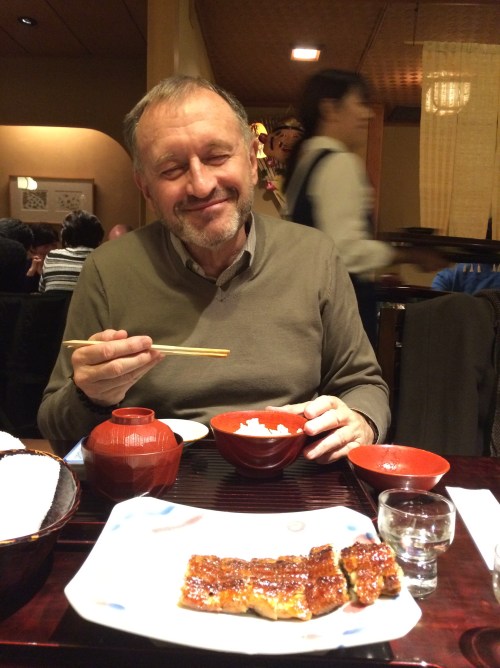
The main show we came for did not disappoint – and went beyond our expectations. We even ordered seconds! Eel tastes like a more flavoursome and delicate version of fish, contrary to expectations not at all slimy and rather crisp and smoky. This one was especially chewy and extra juicy. Mhmmmmmmm! If you can get the image of a cute slippery eel out of your head, I assure you it will sincerely delight you. I’ve tricked numerous (lucky) victims into eating them, telling them it’s ordinary fish – they seem to like it until I tell them what it is!
I know it’s easier said than done to go out there and try challenging dishes. It might have zero persuasive power whatsoever coming from me, who was born an eel-lover. But I hope one day everyone who’s reading this will try grilled eel on rice.
PS: I’m aware this post is kinda boring just focusing on eel, but f the eel-haters because I love eel and I wanted to write about it.
Official Website of Inaka-an(田舎庵): http://www.inakaan.com/unagi/
 Lost in Gustation
You must be logged in to post a comment.